
Khom Khlang EP10 Review: A Magical Finale With a Few Tricks Left Unexplained

Peem and Bulan's love story reaches an emotional conclusion, but even their powerful chemistry can't magically erase every storytelling gap.
OPENING REACTION
We were ready for an epic showdown between siblings, complete with supernatural warfare, physical combat and enough mystical power to make the ancestors proud. With Peem and Bulan facing Zai and his dark arts, Khom Khlang had everything it needed to deliver a legendary final confrontation. Instead, we got something different, and while we're not entirely convinced by every creative decision, we certainly weren't disappointed by everything the finale delivered.
Still, credit where it's due. Star Hunter gave this finale an extended runtime, allowing the story to reach its conclusion without feeling unnecessarily rushed. The episode delivers meaningful family reconciliation, a powerful display of love and a beautifully produced intimate scene that reminds us why we've become so invested in Peem and Bulan.
The magic may not always make sense, but these women certainly know how to cast a spell.
THE MOMENT
A Battle of Power, Faith and Some Questionable Magical Logic
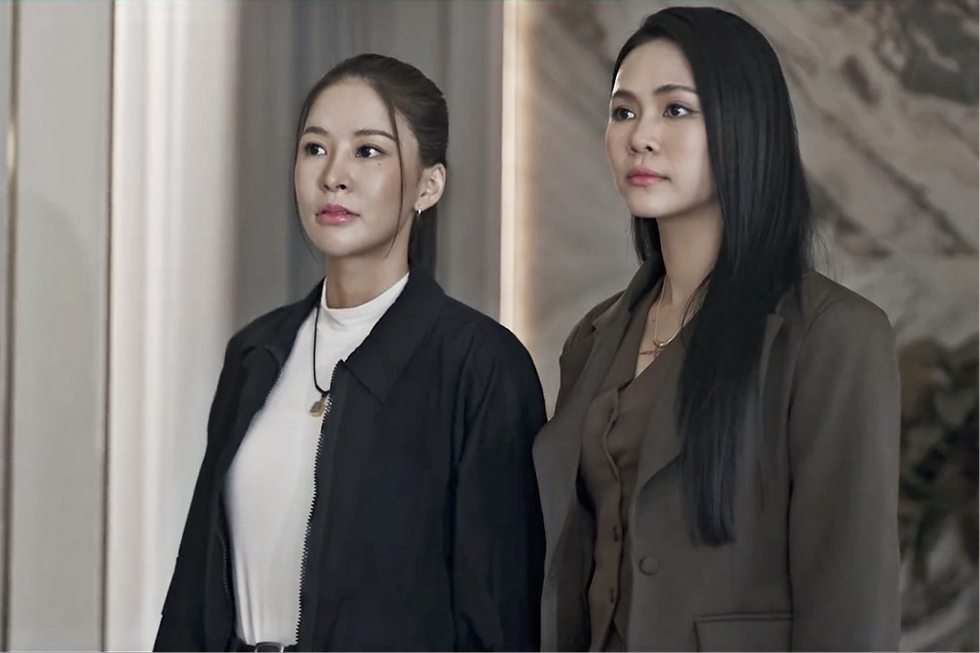
The confrontation between Bulan and her brother, Zai, was the moment we'd been waiting for. When Bulan arrives at her father's home, Bint makes an entrance worthy of the occasion. That outfit, that composure, that commanding presence. Someone clearly understood the assignment because goodness gracious, the woman looked stunning. Bint's dedication to her physical training for this role certainly hasn't gone unnoticed, either. Her toned physique and those famously sculpted abs have been a recurring topic of conversation among fans, and we'd be lying if we said we hadn't admired them ourselves. The hard work deserves its flowers, and the sapphics never stood a chance.
Beyond the visual spectacle, however, the confrontation raises questions about Bulan's abilities that the series never fully resolves.
Throughout Khom Khlang, we've been led to understand that Bulan's powers grow stronger through her love for Peem, her karmic soulmate, and the influence of Peem's charm of meta. With Peem hospitalized and Zai having imprisoned that power, Bulan's vulnerability makes sense. What becomes harder to reconcile is why she summons the tiger against her brother, only to learn that their family crest cannot be used against family members.
Given their father's knowledge of Zai's ambitions and his decision to pass his teachings to Bulan, wouldn't that have been rather important information to share? Even Zai seems surprised by her apparent ignorance. A little supernatural family orientation could have saved everyone considerable trouble.
But what if Bulan knew exactly what she was doing? After watching the confrontation unfold, and admittedly revisiting a few moments ourselves, we couldn't help wondering whether her apparent vulnerability was intentional. We have a few theories:
Bulan was playing the long game. Perhaps she knew the tiger couldn't harm Zai and deliberately allowed him to believe he had the advantage. If her ultimate strategy was to tempt him into accepting powers he couldn't withstand, his hunger for control would become the very thing that destroyed him. That would make Bulan an extraordinarily patient and strategic opponent, which fits the character we've come to know.
Her greatest power is her faith in karma. Bulan's spiritual teachings emphasize goodness, discipline and the consequences of one's actions. Perhaps she never intended to defeat Zai through violence. Instead, she trusted that his destructive intentions would eventually become his undoing. It's a beautiful interpretation that would give her apparent passivity a much deeper meaning.
The two interpretations offer plausible explanations for parts of the confrontation, but none is fully established by the storytelling. And that's where our frustration lies. We don't need Bulan to explain her every thought, but when a character's choices determine the outcome of a supernatural battle, viewers need enough context to understand whether they're witnessing brilliant strategy or unwavering faith.
And this is where Peem comes in, bringing her usual approach to supernatural danger: shoot first, ask questions later.
We adore this woman, but goodness gracious, someone needs to enroll her in Mae Kru's introductory magic course. Having recovered her charm of meta and leaving the hospital, Peem arrives just in time to prevent Zai from driving a knife into Bulan's head. Her gun successfully interrupts his attack, but when the bullets stop cooperating and her enchanted knife proves equally ineffective, Peem discovers that courage, determination and a police badge aren't always enough to win a supernatural fight.
Peem is a capable investigator until Bulan is in danger, at which point her emotions grab the steering wheel and throw the investigative manual out the window. We understand the desperation, especially when the woman she loves is about to be killed, but surely some of Bulan's teachings could have rubbed off by now. Then again, we suspect Peem has been a little distracted during her private lessons with Mae Kru. Can't say we blame her.
Jokes aside, Peem's impulsiveness reinforces how deeply she loves Bulan, even when her actions aren't particularly strategic. What remains unclear, however, is why her return with the charm of meta doesn't produce a more noticeable change in Bulan's abilities. Given everything we've been told about Peem's golden light enhancing Bulan, shouldn't that connection have helped her regain some strength or break free from Zai's restraints?
Instead, Bulan offers to surrender her powers to save Peem, leaving us wondering whether this was her intention all along or a desperate decision made when her lover's life was threatened.
When Power Becomes a Burden
Despite our frustrations with the mechanics of the showdown, the moment Bulan transfers her magic to Zai is one of the finale's strongest sequences, particularly when viewed through the lens of her own spiritual journey.
Earlier in the series, we learned that Bulan's path began during a serious childhood illness. Her father's teachings became central to her recovery, requiring her to develop faith, endure suffering and understand the responsibilities accompanying her abilities. Her magic wasn't simply inherited as a convenient supernatural advantage. It was cultivated through pain, discipline and belief.
That history gives the transfer of power a much deeper meaning.
Zai has spent his life pursuing power as a means of control, revenge and personal gratification. Bulan, by contrast, has learned that genuine spiritual strength requires sacrifice and restraint. When she relinquishes her powers, he receives something he has desperately wanted without possessing the qualities necessary to carry its weight.
The contrast becomes even more meaningful when Bulan collapses from the transfer and Peem, now restrained herself, desperately appeals to the gods to free her so she can protect her lover. Her plea is answered, releasing her from her restraints and allowing her to return to Bulan's side. It's another powerful reminder that Peem's devotion to Bulan is unwavering, even when it means challenging the very spiritual forces governing their world.
As Zai begins to transform, the consequences become terrifyingly clear. His body cannot withstand the power Bulan spent years learning to master. What he believed would make him invincible becomes the very thing that destroys him.
This is also where our earlier theories become particularly interesting. Whether Bulan deliberately orchestrated this outcome or simply recognized an opportunity to let Zai's greed destroy him, the result reinforces one of the series' most compelling themes: power gained without understanding its responsibilities can become its own punishment.
Bulan's use of her mother's lower garment to restrain Zai adds another layer of familial symbolism to the confrontation. As light and dark magic collide, the power he desperately sought becomes his undoing.
Now, how that garment happened to be conveniently available at precisely the right moment is another question entirely. Apparently, even the universe knows when to provide a perfectly timed wardrobe accessory.
What follows, however, is beautifully executed. As Zai succumbs to the overwhelming forces within him, Bulan calls her powers back, and Bint conveys the physical and emotional toll with remarkable intensity. Her scream makes the pain unmistakable, reminding us that these abilities carry a tremendous burden even for someone who has spent years mastering them.
Peem's response makes the moment even more meaningful. As she holds Bulan and uses the protection of her charm of meta to help ease her suffering, their spiritual connection finally becomes something tangible rather than another piece of supernatural exposition.
This is precisely the kind of storytelling we wanted more consistently throughout Khom Khlang: a moment where character history, mystical mythology and emotional intimacy work together. The symbolism is compelling; the performances are powerful and the connection between these women gives the supernatural conflict its emotional weight.
Bint delivers an exceptional performance, and Puinoon meets her with the vulnerability that has become one of her greatest strengths. Their chemistry isn't dependent on grand romantic declarations. Sometimes, it's simply one woman holding the other through unimaginable pain.
WHAT WORKED
a. Peem's Family Confronts the Real Evil: Prejudice
One of the finale's most powerful moments has nothing to do with supernatural battles. Instead, it confronts something painfully recognizable: the belief that a person's sexuality is something shameful that must be corrected.
When Peem's mother takes her to a shaman who attempts to beat the supposed evil out of her, Khom Khlang moves beyond fantasy into a disturbing reality that many LGBTQ people will recognize. The scene evokes the cruelty of conversion practices and the harm caused when religious or spiritual beliefs are weaponized against someone's identity.
What makes this sequence especially effective is Peem's response. Rather than simply resisting her mother's actions, she confronts the underlying belief driving them. If she endures this treatment, will her mother finally accept that there is nothing wrong with her?
It's a devastating question because Peem is asking for something that should never have been conditional in the first place: her mother's love and acceptance.
The attempted cleansing changes nothing about Peem, and that failure becomes the catalyst for her mother's realization. The problem was never her daughter's sexuality. It was the prejudice she had allowed to dictate how she treated her own child.
We particularly appreciate that the reconciliation isn't treated as an instantaneous transformation. The sequence gives the emotional consequences room to register, and both actresses deliver performances that make the eventual shift feel meaningful.
For a series so deeply rooted in spiritual beliefs, this is an important distinction. Khom Khlang doesn't need to reject spirituality to challenge prejudice. It asks viewers to consider what happens when people confuse their own fear and judgment with moral righteousness.
That is powerful storytelling.
b. Sometimes Love Speaks Louder Than Magic
Another standout moment arrives when Bulan senses that something has happened to Peem following the car accident.
Bint's performance here is beautifully restrained until it suddenly isn't. Bulan, normally so composed and almost ethereal in her movements, grabs her chest and immediately runs. That change in physicality communicates the severity of the moment before anyone needs to explain what's happening.
For a character who typically approaches danger with remarkable control, the urgency is revealing. Bulan may have spent much of the series maintaining her spiritual discipline, but when Peem's life is threatened, her love becomes impossible to contain.
Her decision to contact the sergeant and go to the hospital, despite the consequences for her oath, reinforces that emotional conflict. Bulan understands the rules governing her responsibilities, yet she cannot bring herself to stay away from the woman she loves.
We loved this sequence because it allows her actions to reveal what her words often leave unspoken. Sometimes, the most powerful expression of love isn't a grand declaration. It's watching someone abandon their carefully maintained composure because the person they love might be in danger.

c. A Family Reunited
After everything Peem and Bulan have endured, seeing Peem's mother finally embrace their relationship is one of the finale's most rewarding moments. Bint looks stunning in her formal Thai attire, with Bulan noticeably covered from head to toe, concealing the tattoos Peem's mother had previously condemned while under the influence of dark magic. Whether intentional or not, the contrast is striking.
More importantly, Peem's mother's heartfelt apology to Bulan acknowledges the pain she's caused, while her message on love offers a beautiful resolution to the prejudice that once threatened to tear them apart.
The reconciliation becomes even sweeter when the family learns that Peem's brother has awakened. As everyone gathers for a celebratory hug, Peem's sister's ghost makes an adorable appearance, joining the family in a moment of joy. Her presence suggests that her efforts to help her brother recover have succeeded, giving her supernatural involvement a touching payoff.
And then there's Bulan. Bint's subtle facial expressions as she notices the sister's spirit are absolutely delightful. Without saying a word, she reminds us that Bulan experiences a world beyond what others can see. It's a small performance detail, but one that makes the moment even more special.
Between a mother's acceptance, a brother's recovery and a sister's love reaching beyond the grave, this is the kind of family reunion Peem and Bulan deserved.
d. An Intimate Ending Worth Waiting For
Peem's decision to transfer to Bulan's town as a police officer sets the stage for a charming romantic finale, although their ghostly son has already let the secret slip. Their playful patio exchange, followed by Bulan's tender forehead kiss, makes the moment feel wonderfully personal.
Bulan's shift from her signature ceremonial red to white is also a striking visual change after nearly an entire series. Whether it carries a deeper spiritual meaning or symbolizes a new chapter in her life remains unclear, but the timing certainly feels intentional.
That tenderness carries into the bedroom, where Peem's playful confidence and Bulan's increasingly inviting expressions turn affection into desire. Puinoon and Bint communicate beautifully through their eyes, allowing anticipation and subtle gestures to do much of the storytelling. The cinematography is equally impressive, particularly the gorgeous shot of Puinoon's sculpted back as she leans over Bulan. Her dedication to physical training certainly deserves recognition.
And lest we forget Bint, the camera once again treats us to a close-up of her toned abs and beautifully placed lotus flower tattoo. At this point, that tattoo deserves its own billing. Between the two actresses, the sapphics were never going to emerge from this scene entirely composed.
Beyond the visual appeal, the sequence is thoughtfully paced, with a soundtrack that complements rather than overwhelms the emotion. It feels intimate without being unnecessarily elaborate, allowing the actresses' chemistry to carry the moment. It's a fitting conclusion for two characters whose affection has always been as much about what they communicate without words as what they say aloud.
WHAT MISSED
a. Two Questions Surrounding Peem's Grandmother
One continuity question remains unanswered: How did Peem's grandmother obtain the paper and red cloth associated with Bulan's chant to expel the dark spirit possessing Peem's mother? Given the secrecy surrounding the grandmother's earlier visit to Bulan, it's unclear how she acquired these items without raising suspicion. And if this is the same paper damaged in an earlier episode, why does it appear intact?
The second issue is less about continuity and more about a missed emotional payoff. When Peem's family gathers at Bulan's home to express their acceptance, the grandmother interacts with Bulan as though their earlier encounter requires no explanation. We understand their familiarity, but where was the moment Bulan realized that the woman who had sought her help with prosperity and later asked to learn her cooking was actually Peem's grandmother, investigating her under false pretenses?
The source novel gives us that moment. When the family arrives at Bulan's home, Bulan recognizes the grandmother, who apologizes for her deception. It's a small exchange, but one that acknowledges their history and brings their relationship full circle.
The television adaptation didn't need to recreate that scene exactly. Still, a brief moment of recognition, an acknowledgment of the deception or even a simple expression of gratitude would have made the family's acceptance feel more complete. After all, the grandmother's intentions were ultimately rooted in concern for Peem, and Bulan had genuinely helped her without knowing the truth. That deserved a moment of its own.
BOLD TAKE
Khom Khlang delivers a beautifully imperfect finale that proves Thai GL can embrace ambitious supernatural storytelling, even if its magic sometimes requires viewers to do more detective work than Peem herself.
FINAL VERDICT
Episode 10 may not have delivered the epic supernatural showdown we envisioned, but it gave Peem and Bulan something arguably more important: a chance to finally embrace their future together.
We appreciated Star Hunter's decision to give the finale an extended runtime, allowing the emotional moments to unfold without rushing toward the finish line. After everything these women endured, seeing them surrounded by family, free to love and finally enjoying a little peace felt genuinely rewarding. And, of course, Puinoon and Bint made sure their final moments together were anything but forgettable.
The unanswered questions surrounding Bulan's powers leave room for further exploration, but they don't diminish the emotional satisfaction of this ending. Episode 10 reminded us why we fell for Peem and Bulan in the first place, and why we'd happily return to their world for another season.
SERIES RETROSPECTIVE
a. A Different Kind of Thai GL Story
Looking beyond the finale, Khom Khlang deserves recognition for taking a creative risk within the Thai GL landscape.
Rather than building its central romance around a conventional contemporary setting, Star Hunter embraced supernatural mythology, spiritual practices, and elements of Thai cultural tradition. The result is a series with a distinctive visual identity and a storytelling framework that expands what audiences can expect from sapphic entertainment.
As Thai GL continues to develop, the genre benefits when production companies explore different narrative possibilities instead of relying exclusively on familiar romantic formulas. Sapphic characters deserve opportunities to exist within mysteries, supernatural thrillers, historical dramas, action stories and every other corner of entertainment.
Peem and Bulan's romance remains central, but their story unfolds within a visually rich world of family, faith, power and personal responsibility. From its striking locations and costumes to its spiritual mythology, Khom Khlang demonstrates why creative diversity matters to Thai GL. We commend Star Hunter for taking that risk, even when the execution doesn't always match the ambition.
b. The Chemistry That Made Us Believe in Magic
If there's one thing Khom Khlang consistently gets right, it's the relationship between Peem and Bulan. And while it took us many episodes, and admittedly a couple of rewatches, to fully appreciate the production's distinctive approach to intimacy, we came to recognize something rather special.
Across the series' major romantic encounters, Puinoon and Bint develop an almost flirtatious language of their own, often without saying a single word. Their attraction isn't built solely through kissing or physical choreography. It's in the lingering glances, the subtle shifts in expression and the way they study each other's reactions. Their eyes do the flirting, the teasing and, dare we say, some rather delicious dirty talking. And wow, those silent conversations can get interesting.
Peem's desire is often written all over her face. Puinoon gives her a wonderfully expressive quality, particularly when affection turns into anticipation. Bulan, meanwhile, is more restrained and deliberate, making the moments when Bint allows that composure to soften especially compelling. And when Bulan takes control, that confidence is unmistakable. In one memorable encounter, she pulls Peem closer by her hair and guides her downward — a bold improvisation by the actresses that feels entirely true to their characters.
What makes these encounters distinctive is the production's willingness to let anticipation carry the intimacy. Rather than relying on familiar romantic choreography, the camera trusts Puinoon and Bint to communicate desire through their performances, an approach we came to appreciate more with each episode.
Beyond their chemistry, Khom Khlang also makes some remarkably bold creative choices, portraying aspects of sapphic intimacy we've never previously seen explored in Thai GL.
In one particularly bold scene, a woman openly explores her own pleasure while kissing her partner, whose growing desire leads her to take over. It's a striking portrayal of female agency and mutual pleasure that challenges familiar conventions of sapphic intimacy.
Equally noteworthy is the decision to portray Peem and Bulan having sex while Bulan is menstruating. Rather than treating her period as a barrier to desire, the scene embraces it as a natural part of their relationship. It also reveals Bulan's softer, more playful side. Peem teases her about having so many sides, admitting she likes them, while Bulan flirtatiously suggests she stick around to discover the rest. It's a wonderfully confident exchange that makes the scene meaningful beyond its boldness.
Their chemistry also extends beyond romance. Bint brings an almost ethereal quality to Bulan, balancing spiritual authority with emotional vulnerability, while Puinoon gives Peem a passionate, impulsive energy that complements her beautifully. Together, they frequently elevate material that doesn't always provide the strongest narrative foundation. Their ability to make us believe in Peem and Bulan's love, even when the supernatural storytelling leaves us scratching our heads, is among the series' greatest achievements. We'd gladly welcome another project featuring these two, preferably one that gives their chemistry an equally compelling screenplay.

c. The Storytelling Still Has Room to Grow
For all its strengths, Khom Khlang had tremendous potential that wasn't always fully realized.
Our biggest request for a second season would be greater consistency in the supernatural storytelling. The series establishes a fascinating world of spiritual teachings, protective charms and karmic consequences, but clearer explanations of Bulan's abilities, particularly her connection to Peem's golden light, would help audiences better understand the stakes.
We'd also love to see Peem become a more capable bridge between the investigative and supernatural worlds. She's established as a skilled detective, yet her judgment occasionally seems to disappear whenever Bulan is involved. We understand that love can make people a little irrational, but surely our girl can learn a few magical basics without losing her professional instincts.
These improvements wouldn't require abandoning what makes the series special. They would strengthen the foundation beneath its ambitious premise, allowing the supernatural mythology and character development to work together more effectively.
d. Star Hunter's Marketing Deserves a Standing Ovation
Star Hunter deserves a standing ovation for its promotional campaign surrounding Khom Khlang and #PuinoonBint.
From fan events and appearances to promotional experiences throughout Bangkok, including shopping malls, Star Hunter went well beyond traditional trailers and social media posts to keep the series in the spotlight. And goodness, did they keep those women busy.
The results were hard to miss. GL fan communities were buzzing, fellow entertainers were acknowledging the series, and celebrities even dressed as its characters for Halloween. Star Hunter understood something essential about GL fandom: audiences don't simply watch these stories. They build communities around them, celebrate the actresses and keep the conversation going long after the credits roll.
Just as importantly, the campaign helped establish Puinoon and Bint as a duo with appeal beyond their characters. Their appearances and interviews showcased their contrasting personalities, particularly Bint's composed, articulate presence and her delightful ability to turn cheeky when the moment calls for it. Puinoon's infectious energy complements her beautifully, giving fans another reason to connect with them.
From a marketing perspective, we're giving Star Hunter a 10 out of 10. No notes. In our view, it's the strongest promotional campaign we've seen from a Thai GL production house this year.
Now comes the real challenge: sustaining that momentum. Star Hunter has invested considerably in building #PuinoonBint, and we'd love to see that commitment continue through another project, whether it's a second season or an entirely new story that showcases their range.
After building this much momentum, we'd hate to see #PuinoonBint disappear from the spotlight just as they're finding their stride.
The Magic May Be Over, but We're Not Ready to Let Go
Khom Khlang gave us something we'll remember long after the finale: two women whose love challenged prejudice, endured extraordinary circumstances and reminded us that the most powerful magic isn't always supernatural.
For all its imperfections, this is a story we'd gladly revisit, and Puinoon and Bint are a pairing we'd love to see explore new possibilities.
So, Star Hunter, if there's another spell up your sleeve, consider us very interested. These two women have already worked their magic on sapphics around the globe. Surely there's room for one more adventure?


Comments